Two types of Registering an Aerospace Business with SECP in Pakistan
1: Downstream Space Activities
2: Upstream Space Activities
Registering an Aerospace Business with in Pakistan – in Easy 5-five Steps
Registering an aerospace-related business in Pakistan involves multiple regulatory steps, depending on the nature of your activities (e.g., manufacturing, research, aviation services, space technology). Here’s a step-by-step guide:
1. Business Structure Registration
You need to choose a legal structure for your aerospace business:
Sole Proprietorship – Registered with FBR & local authorities.
Partnership (AOP) – Registered with the Registrar of Firms.
Private Limited Company (Pvt. Ltd.) – Registered with the Securities & Exchange Commission of Pakistan (SECP) (Recommended).
Process for Pvt. Ltd. Registration with SECP:
Name reservation via SECP’s e-portal.
Submission of Memorandum & Articles of Association.
Digital certificate of incorporation.
NTN registration with Federal Board of Revenue (FBR).
2. Licenses & Regulatory Approvals
For aerospace-related activities, you may require additional approvals from:
Aviation Sector (Airlines, UAVs, MRO, etc.)
Pakistan Civil Aviation Authority (PCAA) – Licenses for airline operations, drone services, aircraft maintenance, etc.
Airworthiness Certification – Required for aircraft manufacturing or maintenance.
Space & Satellite Activities
Pakistan Space & Upper Atmosphere Research Commission (SUPARCO) – Required for space technology and satellite-related ventures.
Pakistan Telecommunication Authority (PTA) – If the business involves satellite communications.
Defense & Security-Related Aerospace Activities
Ministry of Defence Production (MoDP) – Approval required for military aviation, weapons, or defense-related aerospace projects.
Strategic Export Control Division (SECDIV) – Mandatory for controlled aerospace technologies.
3. Taxation & Compliance
Register for Sales Tax (if applicable) – With FBR and Provincial Revenue Authorities.
Customs Clearance (if importing/exporting aerospace equipment) – Through Pakistan Customs & Engineering Development Board (EDB).
Environmental NOC – From the Pakistan Environmental Protection Agency (Pak-EPA) (if applicable).
4. Special Economic Zones & Incentives
If you plan to set up manufacturing, research, or technology development, you may benefit from:
Special Technology Zones Authority (STZA) – Offers tax exemptions & incentives for aerospace tech businesses.
Pakistan Aeronautical Complex (PAC) – Possible collaboration for manufacturing & R&D.
5. Additional Industry-Specific Registrations
Depending on your activities, you may also need:
Engineering Council Registration (for aerospace engineers & consultants).
ISO & Quality Certifications (for aerospace parts manufacturing).
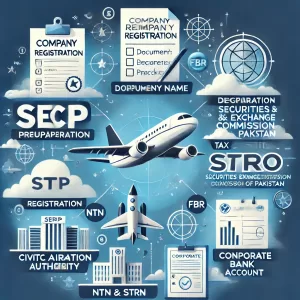
Registering an Aerospace Business with SECP in Pakistan
Registering an Aerospace Business with SECP in Pakistan – in Easy 5-five Steps
To legally operate an aerospace-related business in Pakistan, you need to register with the Securities and Exchange Commission of Pakistan (SECP). Here’s a step-by-step guide:
Step 1: Choose Business Structure
For an aerospace business, the best structure is a Private Limited Company (Pvt. Ltd.) or a Public Limited Company (if large-scale).
Types of Business Entities
Private Limited Company (Pvt. Ltd.) – Best for startups, small-to-medium aerospace firms.
Public Limited Company – Suitable for large aerospace enterprises seeking investment.
Step 2: Name Reservation
Visit the SECP e-Services Portal (https://eservices.secp.gov.pk).
Check for name availability.
Reserve a business name relevant to aerospace (avoid restricted words like “Pakistan,” “Aviation,” or “Defense” without NOCs).
Pay the name reservation fee.
Step 3: Prepare Required Documents
Memorandum of Association (MoA) – Clearly define aerospace activities (e.g., aircraft manufacturing, UAV operations, satellite technology, aviation consultancy).
Articles of Association (AoA) – Outline internal governance rules.
CNICs of Directors/Shareholders – At least two directors required for Pvt. Ltd.
Director’s Digital Signature – Obtain through NIFT (National Institutional Facilitation Technologies).
Company Address & Email – For official correspondence.
Step 4: Company Incorporation
Submit incorporation documents via SECP e-portal.
Pay incorporation fee (varies based on capital).
SECP issues a Certificate of Incorporation within a few days.
Step 5: Register with Other Authorities
After SECP registration, complete the following:
- Tax Registration (NTN & STRN)
Register with Federal Board of Revenue (FBR) for National Tax Number (NTN) and Sales Tax Registration Number (STRN).
Required for tax compliance & invoicing.
- Regulatory Approvals for Aerospace
Depending on your business activities, you may need:
Pakistan Civil Aviation Authority (PCAA) – For aviation-related services (e.g., airlines, UAV operations, aircraft maintenance).
SUPARCO – If dealing with satellite/space technology.
Ministry of Defence Production (MoDP) – For defense-related aerospace manufacturing.
Strategic Export Control Division (SECDIV) – If dealing with controlled aerospace technologies.
- Provincial & Local Registrations
Excise & Taxation Department – For professional tax (if applicable).
Pakistan Engineering Council (PEC) – If dealing with aerospace engineering services.
Step 6: Open a Corporate Bank Account
Use the SECP Incorporation Certificate and NTN to open a business bank account.
Required for financial transactions and investments.
Step 7: Compliance & Reporting
Annual SECP Filings – Submit annual returns.
Tax Filings – File tax returns with FBR annually.
Regulatory Compliance – Follow aviation & aerospace industry laws.
Need Assistance?
PakAdvisor offers business registration services, we can help you navigate SECP registration, obtain necessary licenses, and ensure compliance with aerospace regulations.
Let me know if you’d like a tailored plan! 🚀